
Metro Vancouver Resource Hub
The Challenge
Problem Statement
Residents across Metro Vancouver who are seeking food assistance or housing support often struggle to find clear, trustworthy, and relevant information when they need it most. Existing resources are divided across multiple municipal and organizational websites, each with different structures, terminology, and levels of clarity.
Some users arrive with urgent needs and require immediate direction, while others are in a planning mindset and need time to explore options and understand eligibility. In both cases, the lack of a centralized, easy-to-navigate experience increases cognitive load, slows decision-making, and can discourage users from accessing essential services.
The design challenge was to create a responsive website that enables Metro Vancouver residents to quickly identify and navigate food and housing resources, supporting both urgent needs and exploratory planning without overwhelming users or requiring prior knowledge of the system.
Goals & Objectives
The primary goal of this project was to design a responsive website that helps Metro Vancouver residents efficiently find and evaluate food assistance and housing/shelter resources, regardless of whether they are in an urgent or exploratory mindset.
Core Objectives
Enable users to quickly identify relevant services based on need and location
Reduce cognitive overload when navigating complex or unfamiliar information
Clearly communicate next steps so users know how to access support
Support both quick, goal-directed use and deeper exploration when needed
Present information in a calm, trustworthy, and supportive manner
These objectives guided decisions around information hierarchy, navigation structure, and interaction design throughout the project.
Assumptions & Constraints
This project was completed as a conceptual redesign, which informed several assumptions and constraints.
Assumptions
Users may be experiencing stress, uncertainty, or time pressure when seeking help
Many users are unfamiliar with service terminology, eligibility criteria, or available options
Users may shift between urgent and exploratory mindsets within a single session
Trust and clarity are critical when presenting sensitive, high-stakes information
A centralized, need-based structure is more intuitive than an organization-led one
Constraints
The project was completed by a single UX designer
Scope was intentionally limited to food assistance and housing/shelter services
Research relied on secondary sources and UX best practices rather than direct interviews
Administrative, backend, and service-provider workflows were out of scope
Content accuracy is representative rather than exhaustive
These constraints helped keep the project focused while reflecting realistic UX design limitations.
Research, User Pain Points, Personas & Journey Maps
User Research Approach
Given the sensitive nature of the problem space and the conceptual scope of the project, research focused on identifying common usability challenges through secondary research and pattern analysis.
Research Methods
Reviewed existing Metro Vancouver, municipal, and non-profit resource websites to understand how services are currently organized and presented
Analysed food bank and shelter websites to identify recurring content patterns, eligibility requirements, and points of confusion
Examined UX best practices for designing experiences under cognitive and emotional load
Synthesized insights from publicly shared user experiences and common complaints related to accessing community resources
This approach allowed the project to ground design decisions in realistic user needs while remaining transparent about research limitations.
Key User Pain Points
Research revealed several recurring pain points experienced by users seeking food and housing support:
Fragmented & Inconsistent Information
Resources are spread across multiple websites with different navigation patterns, terminology, and levels of detail. Users must repeatedly reorient themselves, increasing cognitive effort and frustration.
Difficulty Understanding Where to Start
Many users are unsure which type of service applies to their situation or how urgent their need must be to qualify. This uncertainty creates hesitation and delays action.
Overwhelming Content Presentation
Long pages of dense text, unfamiliar language, and unstructured lists make it difficult to quickly assess whether a service is relevant, especially under stress.
Unclear Eligibility & Location Relevance
Users often struggle to determine whether services are available in their area or if they meet eligibility requirements, leading to wasted time and discouragement.
Lack of Clear Next Steps
Even when users find relevant information, it is not always clear how to proceed—whether to call, visit, apply online, or prepare documentation—creating friction at critical moments.
Proto-Persona 1: Urgent Needs Seeker
Name: Alex
Age Range: 30–50
Location: Surrey, BC
Situation: Facing food insecurity and potential housing instability
Tech Comfort: Moderate
Mindset: Stressed, time-constrained, needs clarity fast
Goals
Find nearby food assistance or shelter quickly
Understand what services are available right now
Get clear next steps without navigating multiple websites
Frustrations
Overwhelming lists of resources without guidance
Unclear eligibility or location relevance
Dense language and long explanations during moments of stress
Needs
Simple, need-based navigation
Clear indicators of urgency, availability, and location
Actionable next steps (call, visit, prepare documents)
Proto-Persona 2: Planning & Support Explorer
Name: Maya
Age Range: 20–35
Location: Vancouver, BC
Situation: Seeking information for herself or a family member
Tech Comfort: High
Mindset: Exploring options, planning ahead, wants to understand choices
Goals
Compare different food or housing support options
Understand eligibility and requirements in advance
Save or share resources for future use
Frustrations
Inconsistent information across sites
Difficulty comparing services side-by-side
Not knowing which option best fits her situation
Needs
Structured information with clear categories
Ability to explore without pressure
Trustworthy, easy-to-scan content
User Journey Map
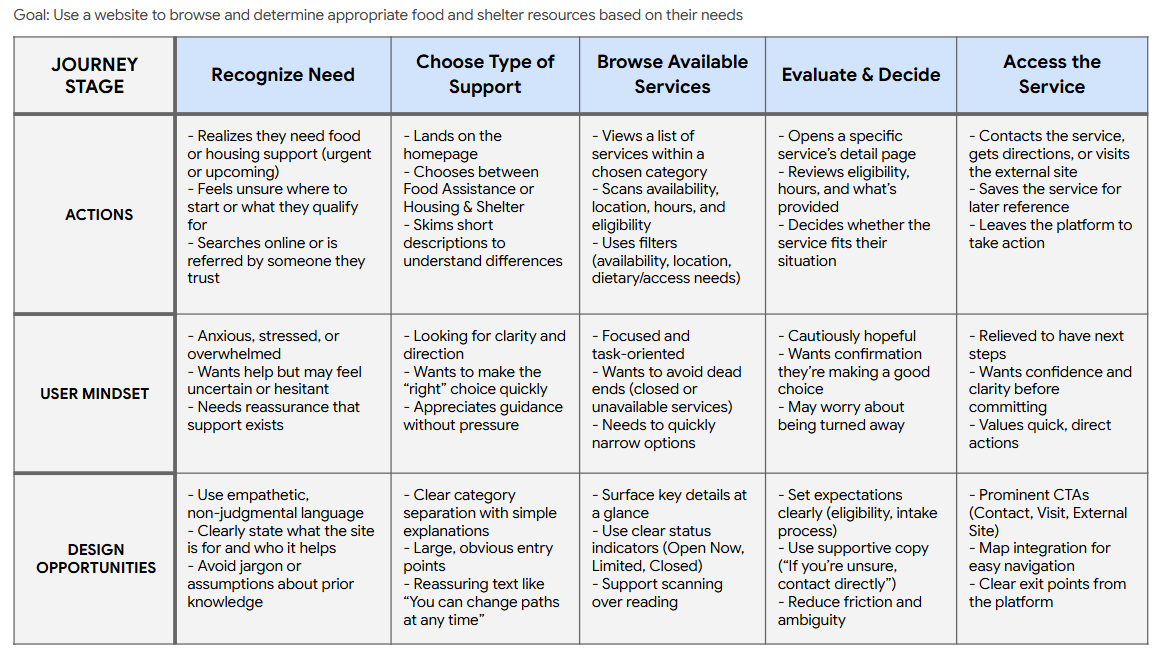
To better understand how people navigate food and housing support during moments of uncertainty or urgency, I mapped a high-level user journey from initial need recognition through accessing a service. This journey focuses on users who may be unfamiliar with available resources and are seeking clarity, reassurance, and actionable next steps rather than deep exploration.
This journey map helped identify moments of uncertainty and stress throughout the resource-finding process, ensuring that navigation, language, and information hierarchy consistently supported clarity, reassurance, and quick decision-making.
Research Summary & Influence on Design
How Research Influenced Design Decisions
These insights shaped early design decisions by emphasizing:
Need-based entry points over organizational structures
Progressive disclosure to prevent overwhelming users
Clear, action-oriented next steps on service detail pages
Flexible navigation that allows users to adjust choices without restarting
A tone that balances empathy with efficiency
Why Personas & Journey Mapping Mattered
The proto-personas and user journey map helped ground design decisions in real user needs, particularly for individuals navigating food and housing resources under stress, uncertainty, or time pressure. By distinguishing between users seeking urgent support and those exploring longer-term options, the personas clarified differences in mindset, information needs, and tolerance for complexity. The journey map then visualized where confusion, hesitation, or reassurance were most likely to occur across the flow, allowing key design decisions—such as simplified entry points, clear availability indicators, and expectation-setting language—to be made intentionally. Together, these tools ensured the experience prioritized clarity, trust, and actionable next steps rather than overwhelming users with information.
This project reflects my interest in designing thoughtful, human-centred experiences that make essential support easier to understand and access.
Questions about this project? Feel free to contact me :)